Gutters Overflowing Even Though They Look Clean? The Hidden Clog
Quick Answer: Gutters that look spotless from the ground can still overflow because the clog usually isn't sitting in the trough where you'd see it. It's packed inside the downspout outlet, jammed in a hidden elbow a few feet down, or matted flat under a thin layer of pine debris you never bothered to clear. A roof valley dumping more water than one downspout can swallow, or a gutter pitched even slightly wrong, causes the same overflow with zero visible debris anywhere. And a system sized for a smaller roof will overflow in a hard summer storm no matter how clean it is, because the problem isn't dirt — it's capacity. Figuring out which one you're dealing with means looking past the trough itself.
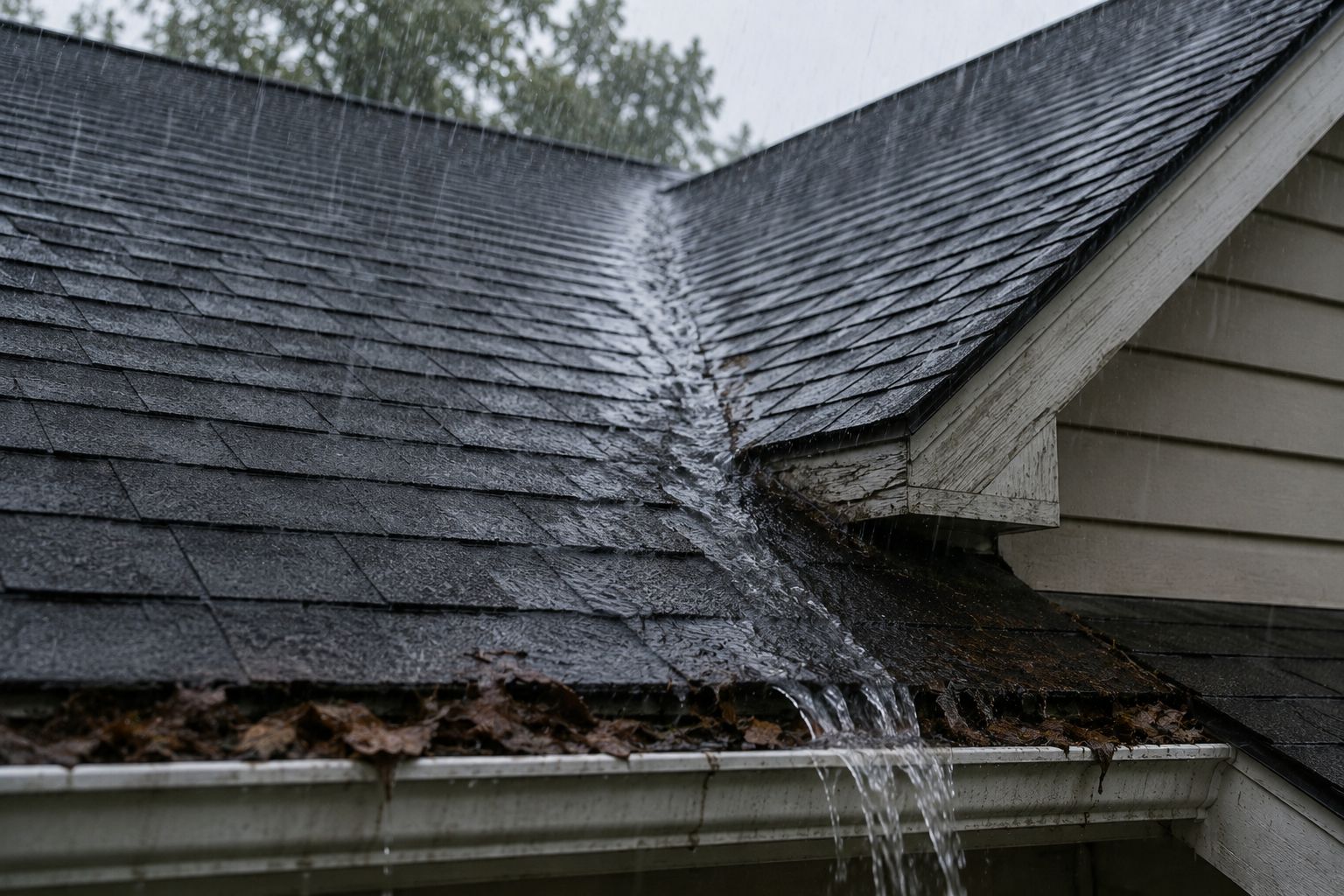
You got up on the ladder after the last storm and scooped out a double handful of leaves near the corner, and the trough looked bare when you were done. No sludge, no nest, nothing sitting in the bottom. Then the next hard rain came through, and water poured over the front edge in the exact same spot as before, running down the siding and pooling next to the foundation like you'd never touched it.
That's the part that throws people off. An overflowing gutter usually gets blamed on leaves, because leaves are the easy answer. But an empty-looking trough and an overflowing gutter aren't a contradiction. They're a clue. Whatever's causing it, a clog, a pitch problem, or a system that's simply too small, is often sitting somewhere you didn't check, in a spot that never shows up when you're standing on a ladder glancing into the trough itself.
Why the Trough Being Clean Doesn't Mean the System Is Clear
A gutter is really two jobs stacked on top of each other. The trough catches the water. The downspout and outlet carry it away. Most people only ever check the first one, since it's the part you can see without taking anything apart. The part that actually decides whether water leaves your roofline or backs up and spills over sits inside a narrow opening you'd need to lean over and look straight down into.
The Outlet You Never Actually Look At
Every gutter run drains into an outlet, a small opening cut into the bottom of the trough where it meets the downspout. That opening is a fraction of the width of the gutter itself, and it's the first place small debris settles, since it's the low point of the whole run. A few pine needles, a wad of shingle grit, a stray twig — none of it has to fill the trough. It just has to bridge that one small gap. Water backs up behind a blockage you'd never spot without leaning over and looking straight down into the outlet, not across the trough.
Pine Straw and Pollen That Mat Down Instead of Piling Up
Metro Atlanta's tree cover skews heavily toward pine, and pine straw doesn't behave like the broad leaves most gutter-cleaning advice gets written for. It doesn't sit in a loose pile you can scoop out with one hand. It falls in thin layers, gets wet, and packs into a flat mat that hugs the bottom of the trough or the inside of a downspout without ever building up real height. The mugginess of a Georgia summer keeps that mat damp long enough to compress instead of drying out and blowing away, the way it might somewhere drier. From a ladder, a thin mat of pine straw can look like nothing more than a light stain. Add a coating of spring pollen, and it gets even more compact, holding water like a sponge instead of letting it pass through. The trough reads as clean because there's no visible pile of anything. The mat itself is the clog.
One Roof Valley Feeding a Gutter That Wasn't Built For It
A roof valley collects runoff from two slopes and channels all of it into a single, narrow stream that dumps into one stretch of gutter. Most of the trough only ever handles water landing directly on it. The section under a valley handles that plus everything both adjoining slopes are shedding, funneled into the same few feet. During a hard rain, that one section can move several times the water of any other part of the run, and it's the section that overflows first even when every downspout on the house is wide open and the rest of the trough is bone dry.
When the Downspout Itself Is the Bottleneck
Not every overflow starts in the gutter at all. Downspouts bend at least once on the way down, usually through an elbow near the top and another near the bottom to route water away from the foundation. Those elbows are narrower than the straight sections above and below them, and they mark the tightest turn the water has to make anywhere in the system. A downspout can run clear its whole length and still choke at a single elbow packed with compressed debris that washed down from the outlet above it.
You won't catch this from the ground or by looking into the gutter, because the trough does its job perfectly right up until the water hits that blocked bend. It backs up the full length of the downspout, then backs up further into the gutter run feeding it, and the overflow shows up several feet from where the actual blockage sits. Homeowners clean the trough, find nothing, and assume the overflow has nothing to do with clogging, when the real blockage is a foot or two down inside a downspout they never looked into.
Tip: A quick way to check a downspout without taking it apart is to run a garden hose into the outlet at the top during dry weather and watch where the water comes out at the bottom. If it doesn't exit cleanly within a few seconds, or backs up out of the outlet instead, the blockage is inside the downspout itself, not the trough.
Water That's Pooling Instead of Draining
Sometimes there's no clog anywhere in the system, and the overflow is happening because the gutter was never pitched to drain properly in the first place. Gutters need a gentle, continuous slope toward the downspout, roughly a quarter inch of drop for every ten feet of run. That's a small enough angle to be hard to eyeball, especially on a house with more than one downspout feeding a single long stretch of gutter.
When a section loses that pitch, whether from a sagging hanger, a run that's settled over the years, or an install that was slightly off from day one, water collects in the low spot instead of moving toward the outlet. In a light rain, that pooled water usually drains slowly enough that nobody notices. In a hard downpour, the same section fills faster than it can empty and spills over the front edge right at the low point, even though the outlet a few feet away is completely clear and taking water just fine. Nothing is actually blocked, so cleaning the gutter changes nothing. The trough tests as clean because it is clean. It just isn't level.
Georgia's clay-heavy soil plays a part here too. Houses settle unevenly on soil that swells and shrinks with moisture, and fascia boards and gutter hangers shift slightly over the years as a result, throwing off a pitch that was correct on installation day. It isn't something you did wrong. It happened slowly enough that you never noticed the trough tilting the wrong way.
Why Georgia Doesn't Need Ice to Cause This
In colder climates, gutter overflow conversation centers on ice dams backing water up under the roofline. That isn't a Georgia problem. What replaces it here is volume and speed. A summer thunderstorm rolling off the Piedmont doesn't spread its rain evenly over a few hours the way a soaking winter system further north might. It dumps a large share of its total rainfall in one short, intense burst, then moves on, so a gutter that handles a steady drizzle without trouble can get overwhelmed by that same rainfall arriving in twenty minutes instead of two hours.
That speed exposes gaps a slow rain never would. A small separation between the back of the gutter and the fascia board, invisible in a light rain because water never gets near it, becomes an overflow point the moment volume spikes faster than the downspout can drain it. Water finds the path of least resistance, and during a fast burst, that path can be a gap you'd never notice standing at ground level on a dry afternoon.
Is It a Clog, or Is the System Just Too Small?
Not every overflow gets fixed by clearing something out. Older homes, additions, and roofs with a lot of connected surface area sometimes end up with gutters sized for a smaller footprint than what's actually draining into them now. A single downspout can only move so much water per minute, and a long run feeding one undersized downspout will overflow at that downspout's end well before the far side of the trough fills.
This shows up as a pattern, not a one-time event. The same section overflows every time, storm after storm, no matter how recently it was cleaned. Clear the trough, check the outlet, run water through the downspout, confirm the pitch, and if it's still spilling over in the same spot during every hard rain, the system likely can't keep pace with the roof feeding it. That's a different fix than a cleaning. It usually means adding a downspout, widening the trough, or splitting the roof's water between more than one run.
Warning: Don't assume a gutter is fine just because it handled a light rain without a hitch. A system with a hidden clog, a bad pitch, or a fascia gap can perform perfectly in a drizzle and still fail completely the moment a fast-moving summer storm hits it with real volume. The only real test is watching it during, or right after, a hard rain.
The Trough Isn't the Whole Story
A gutter that looks empty from the ground can still be the reason water's pooling against your foundation or streaking down your siding after every storm. The debris causing it might be a thin mat instead of a pile, or there might be no debris at all, just a pitch that's drifted off level or a downspout that was never sized to keep up with the roof feeding it. None of that shows up on a quick glance into the trough. Georgia's summer storms are exactly the kind of hard, fast rain that finds every one of those weak points at once, and each storm hitting the same spot stacks a little more water against your fascia and foundation than the last one did.
Frequently Asked Questions
If I just cleaned my gutters and they're still overflowing, does that mean I did it wrong?
Not necessarily. A trough can be completely clear and still overflow if the real blockage is inside a downspout elbow, sitting right at the outlet opening, or if the pitch is off. Cleaning the visible trough only solves the problem when that's actually where the blockage was.
How often should gutters get checked in a yard with a lot of pine trees?
Twice a year at minimum, and again after any stretch of high wind, since pine straw sheds gradually instead of dropping all at once. A gutter that was clear in March can have a packed mat of pine debris by June without ever looking obviously full.
Can gutter guards fix a pitch or sizing problem?
No. Guards keep larger debris out of the trough, but they don't correct a section that's sloped the wrong way, and they don't add capacity to a system that's undersized for the roof feeding it. They help with one specific cause of overflow and do nothing for the others.
Why does the overflow only happen during the heaviest storms and not every time it rains?
Because the underlying issue, whether it's a partial clog, a slight pitch problem, or a downspout that's barely keeping up, only gets exposed once the volume passes what the system can move fast enough. A light rain rarely generates enough volume to reveal a marginal problem.
Is standing water in the gutter after a rain normal?
Describe the item or answer the question so that site visitors who are interested get more information. You can emphasize this text with bullets, italics or bold, and add links.
Get to the Bottom of Your Gutter Overflow
With 15+ years of experience, Absolute Roofing and Gutters
checks more than the trough when a system that looks clean is still overflowing, tracing water through the outlet, the downspout elbows, and the pitch of every run to see whether a six-inch system can keep pace with the roof feeding it. With pine debris and heavy summer storms both testing metro Atlanta gutters right now, another overflow just means more water reaching your fascia and foundation while the real cause stays hidden. Schedule a free
gutter inspection and get a straight answer on what's actually behind it before it turns into a fascia or foundation repair.